
Healthspan, not just lifespan.
Every conversation, every game, every quiet moment builds a personal
baseline. Meaningful change is detected early — long before clinical
instruments would catch it.
A complementary layer to clinical care. Never a replacement.
Seven analytics streams. One personal baseline.
Each stream measured against the user's own individual norm — not population averages. Combined into condition-specific risk estimates, updated continuously, surfaced in the language clinicians and caregivers already use.
Conversation Metrics
- Narrative coherence & lexical richness
- Autobiographical recall accuracy
- Semantic verbal fluency, TTR, propositional density
- Response latency & word-finding pauses
- Temporal & spatial orientation
Visual Pipeline Metrics
- Eye openness, blink health, PERCLOS drowsiness
- Attention & gaze stability
- Head posture & tremor stability
- Facial symmetry (FAST stroke screen)
- Facial-AU pain (PSPI) & emotional tone
Audio Pipeline Metrics
- Speech rate, F0, jitter, shimmer, HNR
- Vocal tremor & articulatory precision
- Hypophonia & prosody
- Cough, breath, snore detection
- Dysarthria & aphasia signatures
Overall Wellness Metrics
- Composite alertness & engagement
- Mood stability & emotional trajectory
- Social connectedness & isolation risk
- Sleep quality & routine stability
- Healthspan summary index
Physical Health Parameters
- Heart rate & HRV via rPPG
- Blood-pressure proxies (PWV / PTT)
- Respiratory rate & SpO₂ spot-checks
- Gait, postural sway & cardiac rhythm via ambient sensing
- Through-wall, no-wearable monitoring
Nutrition Tracker
- Conversational 24-hour dietary recall
- Hydration & appetite trends
- Dysphagia conversational markers
- Medication–nutrition interactions
- Unintentional weight-loss flags
Triaging
- Continuous in-home NEWS2 & qSOFA scoring
- CAM/4AT delirium against a personal baseline
- Multi-epoch fall-risk stratification (immediate / near-term / longitudinal)
- Real-time FAST stroke screen calibrated to the individual
- UTI risk in residents living with dementia · CHF & COPD decompensation composites
- Tiered emergency escalation with timestamped onset and last-known-well
The right view for every stakeholder.
Findings reach human operators in formats calibrated to their role and decision authority — from a frontline caregiver's prioritisation list to a facility CXO's strategic view.
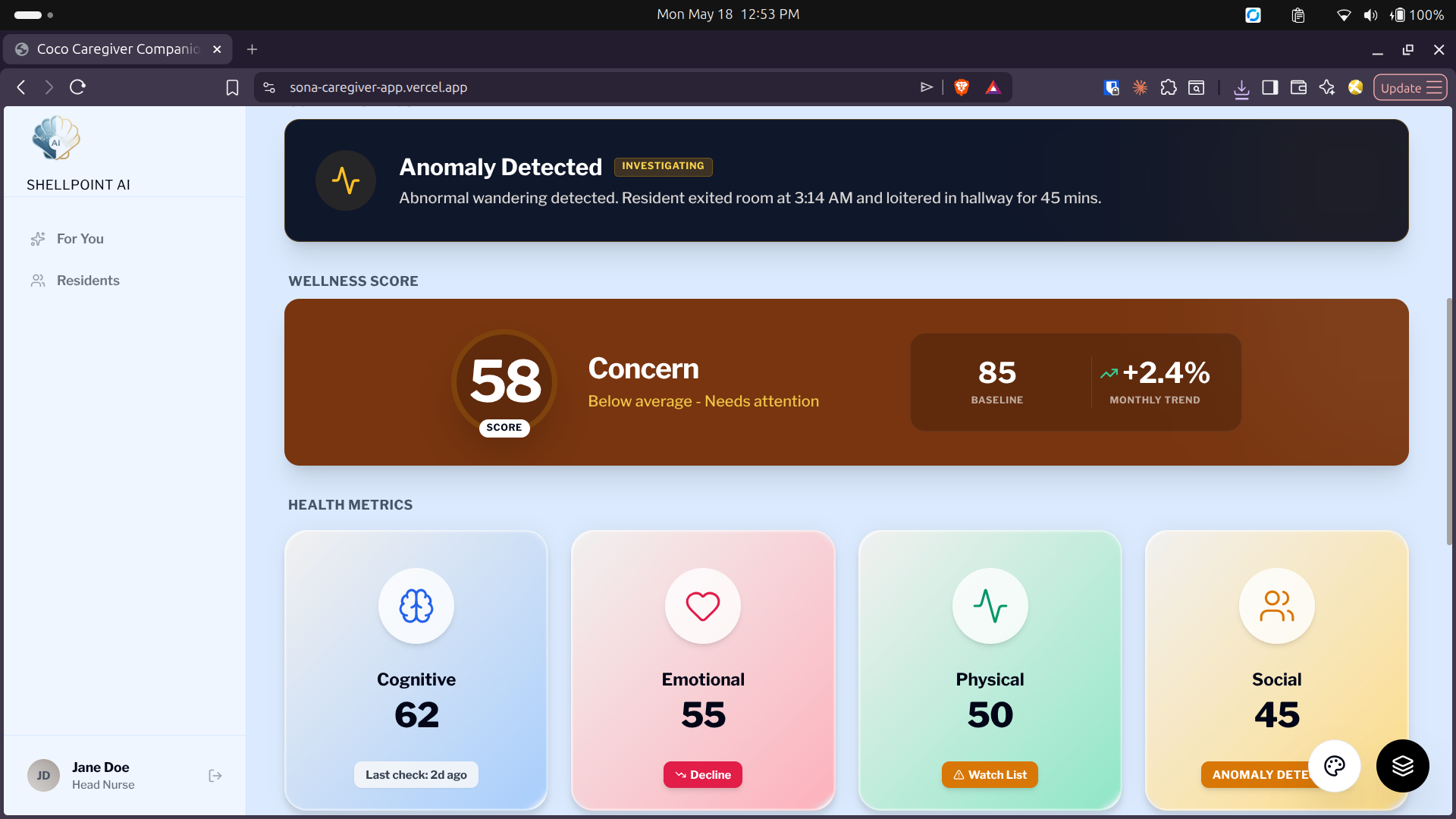
Individual Resident Wellbeing
Engagement, wellbeing, and family connection — mediated through CC itself, never through clinical-feeling screens.
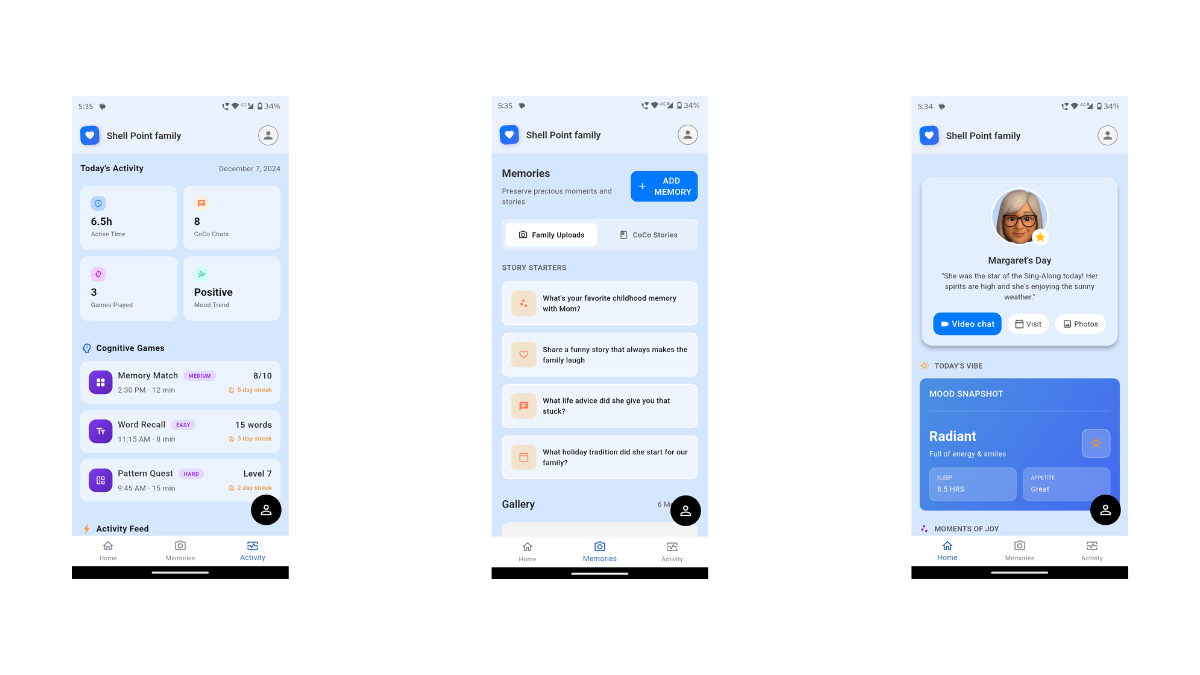
Family Link · for loved ones
Age-appropriate, non-clinical wellbeing summaries. Photo & voice contribution. Trend indicators and notifications.
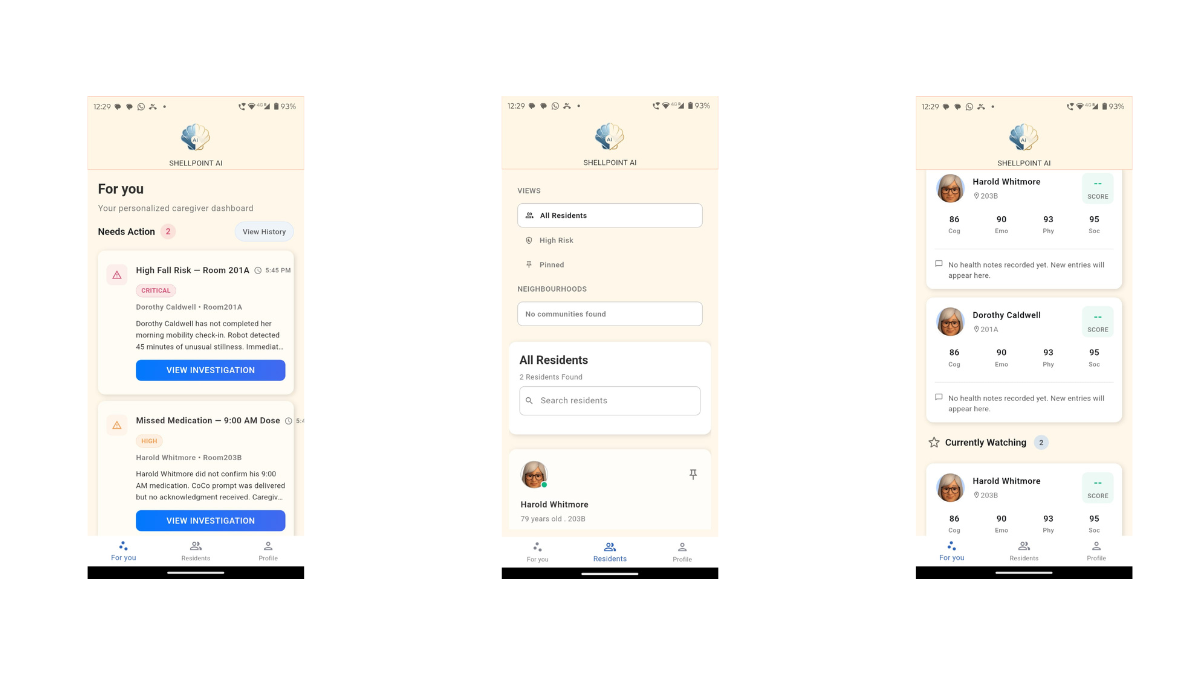
Caregiver App · for the frontline
Real-time alerts, a Nurse Prioritisation List, MOCA-equivalent scores, fall/stroke risk trajectories, and care-task prioritisation.
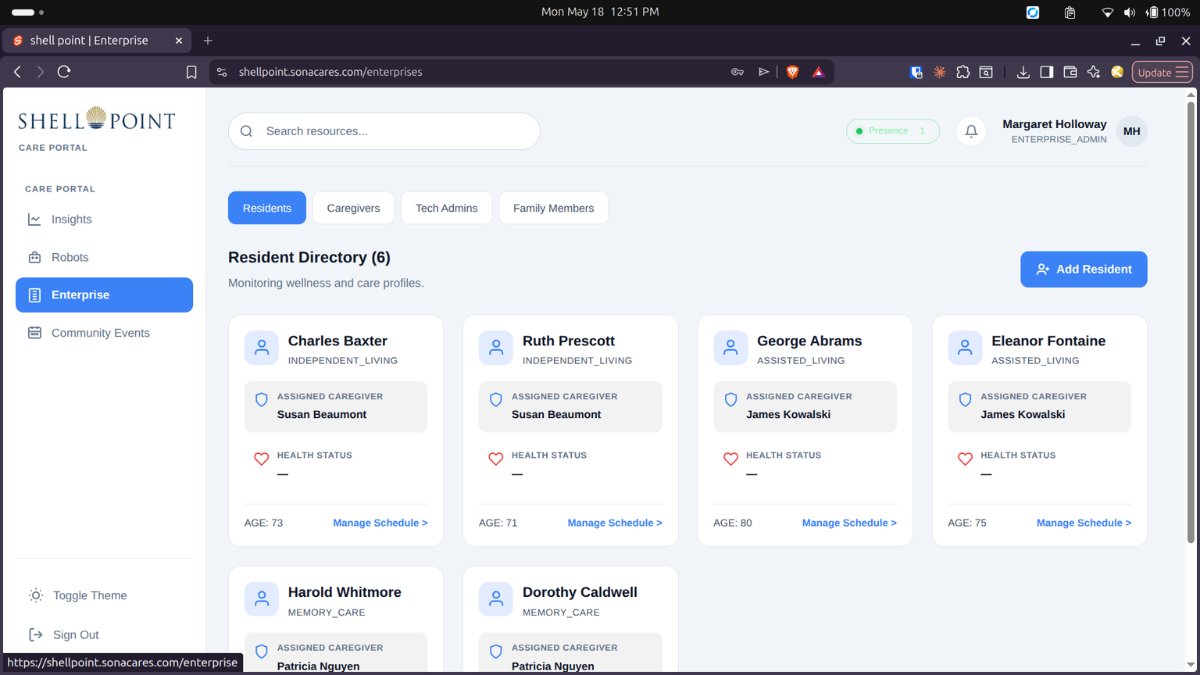
SONA · for clinicians & CXOs
Facility-wide trends, intervention response rates, EHR-formatted exports, and the predictive intelligence used to allocate staff proactively.
The right alert, at the right moment.
CC turns analytics into kindness. When narrative coherence drifts, when sleep quality slips, when articulation softens — CC nudges, gently. A breathing exercise. A reminder. A balance-training game. A check-in. The user feels cared for; the system is, quietly, intervening in the prodromal window where it matters most.
Most importantly: no alert is alarming. Nothing feels clinical. Health support is delivered through the same conversational surface that already feels like a friend.
From reactive rounds to predictive care.
The Caregiver App turns CC's continuous signal into actionable intelligence: a real-time prioritisation list, weeks-ahead deterioration alerts, MOCA-equivalent scores in the format clinicians already trust, and a Caregiver Workload Index that quantifies the time CC has given back. The Caregiver is not replaced — they're dramatically amplified.
The result: every caregiver can monitor far more residents at clinical-grade fidelity, and the residents who most need a human presence get it.